Saturday, September 17, 2016

Under the Greenwood Tree Part 3 - Parson Barnes and the Warp and Weft of Wessex Words

Bronze statue of William Barnes outside the Church of St Peter
 on High Street in Dorchester, UK. Photo by Elliott Brown. 
While Thomas Hardy used his own words to great effect in sketching the Dorset countryside across four seasons in Under the Greenwood Tree, it isn't the only tool in his repertoire for capturing the essence of the people who inhabit it. Dialogue and, more specifically, dialect play an oversized role in the novel, often overshadowing the descriptions written in Hardy's own distinctive voice.

The idea of textually representing Dorset through dialect didn't originate with Hardy. The poet William Barnes began writing poetry in the region's dialect in the 1820s and is the originator of the conceit of referring to Dorset as Wessex; both, ideas for which Hardy is better known. It is no exaggeration to say that without William Barnes, there would have been no Thomas Hardy as we know him. He was, by all indicators, a genius and a polymath.

By the time Hardy would have known him by something other than reputation, Barnes had taken an official position in the Church of England. The pair appeared to establish an acquaintance when Barnes moved the school of which he was the headmaster next door to the office of John Hicks, for whom a young Thomas Hardy was apprenticing. Given what we know of Hardy's impressionable personality as a youth, it's hard to imagine that meeting a published poet with a profound interest in the peculiarities of the Dorset dialect didn't put ideas in his head about his own literary future.

Barnes's approach to approximating the Dorset speech is very different than Hardy's own solutions in Under the Greenwood Tree. The former's interest in philology and rendering the sound of the dialect (not unlike Robert Burns) transforms his poetry into almost a formal academic experiment.

The Fall by William Barnes

The length o’ days ageän do shrink 
   An’ flowers be thin in meäd, among 
   The eegrass a-sheenèn bright, along 
Brook upon brook, an’ brink by brink. 

   Noo starlèns do rise in vlock on wing— 
   Noo goocoo in nest-green leaves do sound— 
   Noo swallows be now a-wheelèn round— 
Dip after dip, an’ swing by swing. 

   The wheat that did leätely rustle thick 
   Is now up in mows that still be new, 
   An’ yollow bevore the sky o’ blue— 
Tip after tip, an’ rick by rick. 

   While now I can walk a dusty mile 
   I’ll teäke me a day, while days be clear, 
   To vind a vew friends that still be dear, 
Feäce after feäce, an’ smile by smile.

Barnes uses language here in some specific ways to evoke the Dorset dialect. The first is a certain freedom in spelling to emphasize its peculiar sounds that extends to the application of diacriticals to indicate dipthongs that occur naturally in speech but can be masked by text. "F''s also regularly transform into 'v''s ("vlock on wing," "bevore the sky," "(t)o vind a vew friends"). Although not demonstrated here, Barnes was also inclined to turn some 's' sounds into 'z's as in this line from his poem, "Zun-zet": "Sorrow-slightèn, work-vorgettèn, / Gambol’d wi’ the zun a-zettèn." Interestingly, in both examples, we can see that Barnes has a place for both the letters F and S in his ear but is differentiating specific placements of them (or perhaps their pronunciation in particular words) by use of the different consonant sound.

As we'll see in the next installment, Hardy may have been inspired by Barnes's experiments but goes about implementing them in very different ways.

Monday, September 5, 2016

Under the Greenwood Tree Part 2 - Word Weaving the Elements

Where the trees are separated from the water-meadow by the River Frome
in Lower Bockhampton, Dorset, UK. Photo by Mike Faherty.
Thomas Hardy's initial focus in Under the Greenwood Tree is, as his subtitle suggests, on the Mellstock Quire - a band of musicians and singers who perform weekly at church services as well as at social gatherings such as weddings and dances. At the ensemble's core is three generations of the Dewy family; the elder William, the patriarch Reuben and the young Dick. The novel opens with the quire meeting up at Reuben's house for a bit of cider before discharging one of its annual obligations - travelling house to house all throughout the night to carol for the people of the parish.

From this introduction, Hardy reveals the three principal threads from which the tapestry he intends to hang behind the plot is woven; specifically, location, language and convention. In this piece, we look at the first, location.

Unlike Desperate Remedies, which merely borrows from known places in order to make its setting believable, Under the Greenwood tree is a novel about a particular place, Mellstock, as well as the people who inhabit it. Mellstock is, in reality, Hardy's ground-zero, Stinsford and the associated communities at Lower and Higher Bockhampton, the latter of which being his birthplace. The geographic scope of the novel is limited to this area with only a brief foray south into Budmouth (the port city of Weymouth) and a few times to the north and east at Geoffrey Day's house in Yalbury Wood on the road to Weatherbury (Puddletown).

Hardy's captures its essence in winter in this description of the surrounding landscape, gliding adroitly between physical details and a poetic rendering of the sum effect of seeing it in this early passage.

The lonely lane...connected one of the hamlets of Mellstock parish with Upper Mellstock and Lewgate, and to his eyes, casually glancing upward, the silver and black-stemmed birches with their characteristic tufts, the pale grey boughs of beech, the dark-creviced elm, all appeared now as black and flat outlines upon the sky, wherein the white stars twinkled so vehemently that their flickering seemed like the flapping of wings. Within the woody pass, at a level anything lower than the horizon, all was dark as the grave. The copse-wood forming the sides of the bower interlaced its branches so densely, even at this season of the year, that the draught from the north-east flew along the channel with scarcely an interruption from lateral breezes.

Hardy manages to work in at least one such word painting per season, around the changing of which the novel is structured. As Dick Dewy makes his way from Mellstock to Yalbury Wood in springtime to engage Fancy Day in her father's house for the first time, Hardy paints the scene. Notice again how light is used to frame the scenery.

[H]e was journeying along with Smart the mare and the light spring-cart, watching the damp slopes of the hill-sides as they streamed in the warmth of the sun, which at this unsettled season shone on the grass with the freshness of an occasional inspector rather than as an accustomed proprietor...The distant view was darkly shaded with clouds; but the nearer parts of the landscape were whitely illumined by the visible rays to the sun streaming down across the heavy gray shade behind...

Later that summer, after Dick and Fancy have undertaken a secret engagement, Hardy places more emphasis on the interplay between water and the flora fed by it.

It was a morning...of lingering dews, when grass is never dry in the shade. Fuchsias and dahlias were laden till eleven o'clock with small drops and dashes of water, changing the colour of their sparkle at every movement of the air; and elsewhere hanging on twigs like small silver fruit.

In the autumn, as the certainty of Fancy and Dick's shared future begins to waver under pressure from multiple fronts, the sun and its associated effects take center stage again.

The landscape being concave, at the going down of the sun everything suddenly assumed a uniform robe of shade. The evening advanced from sunset to dusk long before Dick's arrival, and his progress during the latter portion of his walk through the trees was indicated by the flutter of terrified birds that had been roosting over the path. And in crossing the glades, masses of hot dry air, that had been formed on the hills during the day, greeted his cheeks alternately with clouds of damp night air from the valleys.

Returning to the tree imagery of the opening passage, Hardy blends it with his water theme from the summer as well as an interest in kinetic motion from the wind to stirring effect in this dramatic scene as Fancy travels to meet with the witch of Mellstock, Elizabeth Endorfield.

A single vast gray cloud covered the country, from which the small rain and mist had just begun to blow down in wavy sheets, alternately thick and thin. The trees of the fields and plantations writhed like miserable men as the air wound its way swiftly among them: the lowest portions of their trunks, that had hardly ever been known to move, were visibly rocked by the fiercer gusts, distressing the mind by its painful unwontedness, as when a strong man is seen to shed tears. Low-hanging boughs went up and down; high and erect boughs went to and fro; the blasts being so irregular, and divided into so many cross-currents, that neighbouring branches of the same tree swept the skies in independent motions, crossed each other or became entangled. Across the open spaces flew flocks of green and and yellowish leaves, which, after travelling a long distances from their parent trees, reaches the ground, and lay there with under-sides upward.

The autumnal section is closed as the final threats to the Dewys' future happiness are removed one after another and Hardy narrows his eye to the interplay of water and the landscape surrounding.

It was a foggy morning, and the trees shed in noisy water-drops the moisture they had collected from the thick air, an acorn occasionally falling from its cup to the ground, in company with the drippings. In the meads, sheets of spiders'-web, almost opaque with wet, hung in folds over the fences, and the falling leaves appeared in every variety of brown, green, and yellow hue.


The story ends with a spring wedding celebration that takes place, as we might suspect, under the titular greenwood tree. Hardy describes the march to the church in a curiously oblique fashion, as if it were happening to someone who was merely an observer and not a true participant, with this beautiful image while the actual wedding takes places off-stage, so to speak.

Now among dark perpendicular firs, like the shafted columns of a cathedral; now through a hazel copse, matted with primroses and wild hyacinths; now under broad beeches in bright young leaves they threaded their way into the high road over Yalbury Hill, which dipped at that point directly into the village of Geoffrey Day's parish.


By isolating particular elements (trees, wind, light and moisture) and manipulating our awareness of them across four seasons, Hardy makes the landscape in his tightly-framed story come alive. He uses these word-paintings to heighten the drama of certain scenes, perhaps to a tenor beyond what the sometimes flimsy story demands. It is a skill that would serve him well as the complexity and consequences of his socially driven plots grew with his skill as a writer of fiction.

Saturday, September 3, 2016

Interlude - By Way of Explanation

Living British writer Alan Moore
Greetings all! I hate doing posts about not posting but I figured after nearly two months radio silence that an explanation was in order. In mid-July, I secured an opportunity to interview British writer, Alan Moore, for World Literature Today magazine, of which I am the book review editor. He has a new book, Jerusalem, that is dropping very, very soon.

It's 1300 pages long.

Moore is, far and away, my favorite living writer and gaining the opportunity to interview him is the achievement of a life-long goal. I had one month to read this life-altering but very long book and prepare questions for an author who has been an inspiration to me for more than 20 years.

The good news is I finished the book and conducted the interview on August 25th. I think it went very well and, Lord willing and if the Creeks don't rise, it'll be in the January issue of the magazine. There are some interesting (and not altogether obvious) correlations between Hardy and Moore's works that will be obliquely addressed in the piece so, when the time comes, I'll share it here along with my thoughts on what elements, textual and otherwise, link them in my mind.

The bad news is/was that there was no way I could meet those goals and work on this blog. Now that it's behind me, I'm going to get started again here very soon. I actually am in the process of reviewing Under the Greenwood Tree and my original notes to get back into the headspace to write about it.

In the meantime, I thought I'd share a Hardy poem with which you may not be familiar. I was gifted two books of Hardy criticism from a friend's library and, inside of them, was a Hardy poem cut out of a magazine of unknown origin (though the photography in an ad on the back side suggests early 1960s). This poem, "The Unplanted Primrose," is dated 1865-1867 and, according to the tiny text at the bottom, was "discovered by Miss Evelyn Hardy [ed. note, noted Hardy critic but, as far as I can tell, no relation] among the unpublished papers of Thomas Hardy." I've only spotted it online embedded in longer papers and books so why not reprint it here for your enjoyment?

The Unplanted Primrose

"A pink primrose from the plant he knows
      Let me send him in his far spot,
 From the root I brought to his garden-knot
 When he dwelt herefrom but a little mile;
 A root I had reared at that time of love,
 And of all my stock the best that throve
     Which he took with so warm a smile."

Such she sang and said, and aflush she sped
     To her love's old home hard by
Ere he left that nook for the wider sky
Of a southern country unassayed.
And she crept to the border of early stocks,
Of pansies, pinks and hollyhocks,
     Where their vows and the gift were made.

"It has not bloomed!" And her glances gloomed
     As she missed the expected hue,
"Yet the rest are in blow the border through;
 Nor is leaf or bud of it evident.
 Ah, can it have died of an over-care
 In its tendance, sprung of his charge to spare
     No pains for its nourishment?"

She turned her round from the wrong ones found
     To the seat where a year before
She had brought it him as the best of her store,
And lo, on a ledge of the wall she neared,
Lay its withered skeleton, dry and brown,
Untouched since there he had laid it down
     When she waved and disappeared.

1865-1867 Westbourne Park Villas

16 Westbourne Park Villas, W2, London
where the poem was written.

Sunday, July 10, 2016

Under the Greenwood Tree Part 1 - Going Dutch

A tree at the junction of the North & South Warren Hills
outside of Beaminster, Dorset. Photo by Graham Horn (2008)
Thomas Hardy's second published novel, Under the Greenwood Tree, bears the curious subtitle of "The Mellstock Quire: A Rural Painting of the Dutch School." It's easy to overlook this as an authorial eccentricity but, as it turns out, heeding it is of vital importance in the task of enjoying this novel for what it is, rather than what it half-heartedly pretends to be.

During Hardy's extended stay in London (beginning in 1860), he tried on a number of creative hats above and beyond his work as an architect's assistant, including that of an art critic, though he probably would have thought of it more as art journalism. He spent many hours in the museums of London studying the work of the great master painters, developing an eye to perceive what techniques could be used to achieve what ends as well as a language to articulate what he saw. Indeed, many of Hardy's novels rely a kind of painterly language to describe landscapes and scenery in particular and imbue those descriptions with a poetic register more often reserved for feelings or people in other novelists' work.

So when Thomas Hardy says that he's writing something as "A Rural Painting of the Dutch School," it behooves us to take that seriously as he, no doubt, did in proclaiming it. I am not an art expert so I'm drawing from ideas that can be gleaned from a Wikipedia article and a couple of YouTube tutorials. I have no doubt that Hardy may have found more levels on which to weld his rural idyll to the conceptual framework of Dutch painting but here are the ones that pertain most obviously to Under the Greenwood Tree.

The first is precision in detail. If Desperate Remedies offered a hint at Hardy's future gift for describing people, places and things, it is Greenwood Tree where this impulse sees it first full expression. We'll be looking in particular at how Hardy uses his descriptions to compose a kind of emotional soundtrack to lay beneath his rather simple plot that gives it more heft.

Second, painters in the Dutch school are remembered for their choice of subject matter, elevating the lower above the greater. They liked to paint landscapes with no people in them. They selected more mundane items to foreground in their compositions. The working class became the subject of their portraits in lieu of dignitaries.

I believe that this applies to Greenwood in two different ways. First, this is a story about simple Dorset folks of limited social importance in the grand scheme . The most elevated characters in the book (Geoffrey Day, Fred Shiner and Parson Maybold) are a land steward (like Manston in Desperate Remedies), a farmer and a clergyman respectively. The novel's primary energies are tasked with recreating the complex social web that exists among Dorset folk, which brings me to my third and final point.

The love story which drives Under the Greenwood Tree's plot serves only as a frame to dictate the span of Hardy's panoramic sketch of the rural life in which he'd grown up. This is a secondary inversion of the "lower above the higher" variety as the setting and supporting characters are the genuine subjects of this portrait. As a result, the main characters are only broadly sketched and offer little in the way of depth to examine except for the dimensions in which they relate to the explication of the social systems of which they are a part. I do think there is one macabre implication in the plot worthy of mention as it is so classically Hardy so we'll explore that a little as well.

Photo Credit - By Graham Horn, CC BY-SA 2.0, https://commons.wikimedia.org/w/index.php?curid=13662099

Monday, July 4, 2016

Writing Under the Greenwood Tree

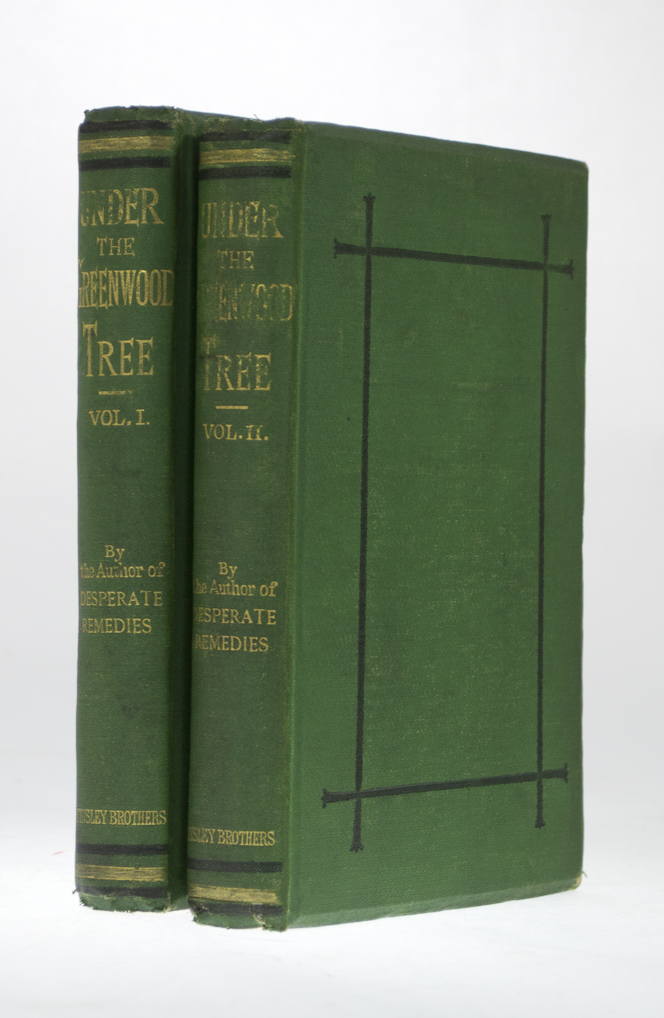
The original two-volume edition
of Under the Greenwood Tree from
the Tinsley Brothers publishing house.
There is an apocryphal story about filmmaker Quentin Tarantino suggesting that he arrived in Los Angeles with one movie in his mind to make, but it was so sprawling that he couldn't convince anyone that it was filmable. In time, that one movie morphed into a string of films that formed the bedrock of his legacy: Natural Born Killers, True Romance, Pulp Fiction and Reservoir Dogs.

In the same manner, Thomas Hardy's unpublished The Poor Man and the Lady served as the springboard for several of Hardy's early novels including the first published under his own name, Under the Greenwood Tree. It is a testament to what a beast of novel Poor Man must have been that both Desperate Remedies and Under the Greenwood Tree are supposed to contain large swaths of material from it but could not be more distant from one another in tone, focus and execution. Indeed, Hardy claimed to have begun Greenwood before abandoning it for what must have seemed like a more commercially viable approach to the plot-driven Remedies.

Desperate Remedies had been neither the resounding hit nor unmitigated failure that might have given Hardy a clear sign of what to do next. He had earned only about two-thirds of his initial investment in the book back, despite some positive reviews in conspicuous places. He began the process of placing his second novel in August of 1871 with the same publisher where he began, with Macmillan, offering Under the Greenwood Tree as a novel which built upon the positive feedback he'd gotten from readers about his ability to portray rural life in a convincing manner. Hardy steers its plot (such as it is) studiously away from any questions of moral impropriety that might have alienated Macmillan from publishing Poor Man.  

Under the Greenwood Tree's length (or lack thereof) proved to be an impediment in selling Macmillan on it as a publishable property. As the novel publishing business in England at the time was built on a model of books of a particular length (the three-volume model), moving something other than that may have been a privilege afforded to those who had proven their ability to attract an audience, which Hardy had not. It also lacks a certain narrative heft in the pages it does fill that may have made it seem even more slight than it was by page count.

Though Hardy was encouraged by their willingness to correspond with him on the possibility of publishing it, he was sufficiently convinced of their lack of interest in publishing it by October of that same year to begin seeking out other options. He crafted a letter to William Tinsley. who had published Desperate Remedies, alerting them to a favorable late review (penned by his friend Horace Moule) and dangling the possibility of two other novels, Under the Greenwood Tree and the not-yet written A Pair of Blue Eyes. Tinsley showed alternate moods of interest and disinterest in taking on Hardy's next novel until April of 1872, when Tinsley offered Hardy £30 for the copyright of the novel.

It behooves us to remark on the slow transition taking place in the publishing industry at that time, one that reflected the growing power of individual authors in relation to the publishing companies that brought their works to market. Hardy had availed himself of the less attractive of the two choices of the old paradigm, paying Tinsley a £75 guarantee against the publication of Desperate Remedies. This offer represented the other, guaranteeing Hardy £30 profit on the sale of his second novel but at the expense of his control over the work unto perpetuity. Before long, the industry would move towards the payment of royalties in exchange for temporary control of the copyright. This benefitted publisher and author alike as it lowered the non-manufacturing costs associated with publishing a book from a popular author (ie the advance) while guaranteeing a longer-term source of income (if the book were successful) to its author. These are the terms by which Hardy eventually would be able to make a living as a writer of novels but those days were yet some years in the future.

And so, desperate to build on whatever momentum he had accrued through the publication of Desperate Remedies, Thomas Hardy signed away the rights to his second novel to Tinsley in April of 1872 and the two-volume edition was published in June of that same year. It was the only novel for which he was never able to buy back the rights to regain control of the copyright.

Saturday, June 18, 2016

Another Milestone!

Illustration by Shayna Pond (2016) for JLS
Please cite artist and blog if you reuse.
I didn't have much opportunity to write for the blog this week as I had a big show this week opening a local blues/jazz festival. I'm reading Under the Greenwood Tree and a couple of other Hardy-related titles right now but I don't have anything specific upon which to report yet.

In the meantime, the flurry of activity at the end of our discussion of Desperate Remedies pushed the all-time page views up over 15,000 since March.

I want to celebrate these little victories while acknowledging that these big bumps in views happen when the good folks at the Thomas Hardy Facebook page share one of my posts (in this case DR Part 7) with their nearly 200K followers. That post was viewed more than 3,500 times, while the majority of my organically supported posts (such as my recent review of Arthur Mee's Dorset) are usually viewed by somewhere between 50 and 80 people.

Call me simple but the fact that somewhere between 50 and 80 people take the time out of their day to exercise their enthusiasm for Thomas Hardy's writing by reading this blog thrills me. I've found pockets of wonderfully sociable Hardy readers at the Thomas Hardy Fans FB page and Goodreads who have given me lots of support and feedback and it means a lot to me. Thanks to all of you - friends, family, strangers alike - who stop in to follow along.

I'd like to give a final shout-out to my wife, Shayna, who has graced this blog with several outstanding illustrations, including the one attached to this post. She made that one for me for a one-of-a-kind t-shirt [editor's note: said t-shirt and the illustration which adorns it was a wedding anniversary gift] which should arrive later this month. I'm going to make the shout-out extra loud because I groused at her literally this moment for asking me about another obligation I had made freely but had yet to fulfill. And then she brought me some iced tea. She's wonderful and I am still a project under improvement.

Thanks, y'all.

Sunday, June 12, 2016

Review: The King's England (Dorset) by Arthur Mee

The King's England: Dorset is a quaint book that offers an exhaustive survey of the towns and accompanying landmarks of Dorset as they stood in 1939. The author, Arthur Mee, wrote a series of these books, covering all the counties in England, and this one, published just over a decade after Hardy's death, is written through a filter of identifying landmarks that might appeal specifically to admirers of TH's work.

As one might expect, there is a LOT in here about the churches that serve as the anchor for most, if not all, of these towns but geography and history are given a fair amount of consideration as well. Mee focuses a lot of his description on delineating the layers of pre-Roman, Roman, Saxon, Norman and British influence on the architecture that really drives home how long these lands have been occupied.

There is a somber tone that underpins this book as one is regularly reminded of the trouble brewing in Europe as it is being written and published and it's hard not to read a "We better document this while it exists" subtext into it. This proved to be true, though not as apocalyptically as Mee might have feared, as later editions of the London volume had to be extensively re-written and broken into multiple volumes to accommodate the rebuilding after the bombing of the Second World War.

Judging solely from the Dorset edition, I enjoyed reading Mee's writing. He's not afraid to take an opinion or pass a judgment on an historical event or person and it feels like something written by a person and not a tourism board. His writing is, on occasion, lyrical and always thorough. The survey as a whole is undermined by the alphabetical listing of the towns, which makes the continuity of geographic proximity tougher to parse than it should be.

There are plenty of nods to Hardy and the many roles Dorset plays in his work to satisfy those who might consider this volume as a reference to their own interest in the West Country's favorite son.